AC Mold Cleaning in Dubai: Why Cleaning the Filter Isn’t Enough
Why do you keep sneezing every time you enter your room, and for no clear reason? Ever thought about that? It is probably because you have a moldy Air Conditioner. No, you have been cleaning your AC filter regularly, right? So this shouldn’t be happening. Regardless, it is happening, and not because the AC filter is not clean, but that alone isn’t enough to prevent the mold.
We are not saying that clearing the filter is unnecessary. But every time you pull out the filters, give them a quick rinse, and pop them back in, it gives a false sense of security. This definitely is a reasonable first step, but one that barely scratches the actual problem. So what exactly is the actual problem, and how can we tackle it? At Moltocare, we have answers for all such questions, and we are happy to tell you more.
Why isn’t cleaning the filter solving the problem?
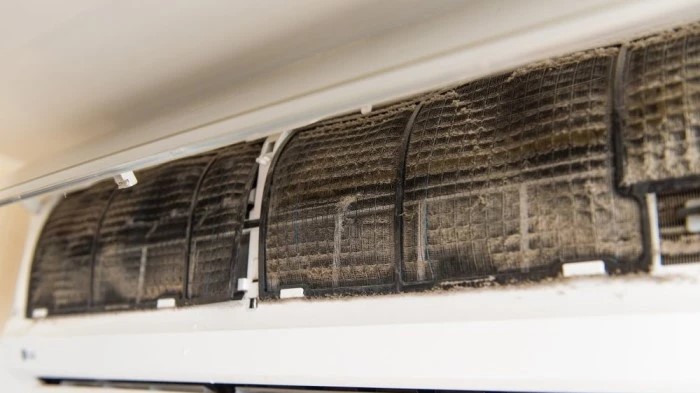
Cleaning the filter only clears out the dust and not the mold. Unlike popular belief, mold doesn’t sit on the surface where you can easily reach and wipe off, but hides within the dark, damp crevices of the Air Conditioning system, turning your cooling unit into a silent distributor of spores.
As your go-to AC cleaners in Dubai, we see this often at Moltocare. We know you live believing that you are breathing fresh air because your AC filters remain spotless, even though you suffer from that musky smell that does not go away, no matter what you do. We know it’s probably not easy to hear this, but your DIY filter cleaning is only doing 10% of the job, and for the rest 90%, you need a professional AC cleaner, or in other words, us!
Why Dubai is a perfect environment for Air Conditioner Mold
Well, you guessed it; the one thing that makes Dubai a favorite of AC mold is its climate. The humid, hot climate makes it a breeding ground for mold all year round. When warm, moisture-loaded air passes through a cold AC unit, condensation builds up inside the system.
That moisture settles on the coils, inside the ducts, and around the drip pan. A little dust to the mix, and you have created an ideal space for mold and fungi to grow.
Since your Air Conditioners run year-round without rest, they have very little downtime for the system to dry out. Besides that, mold doesn’t need much time to take hold. Once it does take hold, it spreads through your ductwork and gets pushed into every room each time the AC runs.
Contrary to what you might think, this is not a cleanliness issue unique to older buildings or dirty living spaces. It happens in brand new buildings, too. In short, the combination of constant use of Air Conditioners and Dubai’s climate makes every AC system a potential mold host.
The anatomy of an AC system: where mold hides
Air Conditioners are a complex network of coils, trays, and ducts. So, cleaning the filter is similar to washing the windshield of a car. It is not doing much except for keeping the surface looking clean.
- The Evaporator Coils: As the AC cools the air, moisture from the humid atmosphere condenses on these metal fins. This creates a perpetually damp environment. Part of the dust that slips past the filters sticks to these wet coils, making it easier for the mold to grow.
- The Blower Fan and Motor: The fan in your AC system is what pushes cold air into your room. However, over time, the same fan collects a layer of sticky dust, which is basically a mix of moisture and dust particles, on it. So, mold starts growing directly on the fan blades. This means that every time you turn the AC on, it is literally throwing mold spores into your room.
- The Condensate Drain Pan: The condensate drain pan is the tray that is set beneath the coil to catch dripping water. If the drain line is slightly restricted, which is a common issue in sandy areas, water sits stagnant. This becomes the perfect breeding ground for thick, jelly-like mold and bacterial biofilms.
What does the filter actually do?
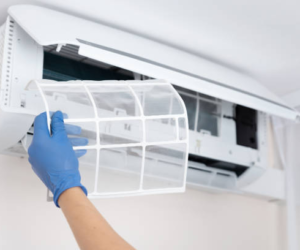
The AC filter is designed to catch dust, pet hair, and larger airborne particles before they enter the Air Conditioning system. Therefore, cleaning your AC filter helps with airflow and energy efficiency. But as you already know by now, mold does not start growing on the filter but deeper inside the system.
When mold forms on the evaporator coils, inside the air ducts, in the drip pan, or around the air handler, the filter does not have much of a role in controlling its spread across the system. In short, AC mold cleaning is not part of the functions of a filter. By the time the mold is visible or smelly, it has already spread beyond the filter. This is why wiping or even replacing the filter at this stage does nothing to remove the source of the problem.
Signs you have a mold problem in your AC
Although the signs are obvious at times, that is not always the case. So, if you notice any of the following signs, you can have an AC mold cleaning session scheduled for the same week.
- A musty or stale smell that appears when the AC starts
- Sneezing, runny nose, itchy eyes, or similar allergy-like symptoms that go away once you leave your home
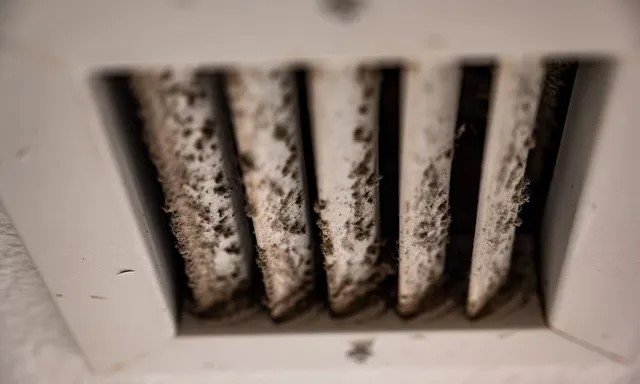
- Visible dark spots around AC vents or on the grills
- Headaches or fatigue that seem worse indoors
- Respiratory discomfort, especially in children or elderly family members
- Water stains or moisture marks near vents
Filter cleaning vs. AC mold cleaning
| Filter Cleaning | Mold Cleaning | |
|---|---|---|
| Target | Surface dust and debris | Mold, bacteria, fungi |
| Time taken | 10–15 minutes | Several hours |
| Tools | Brush, water | Specialized equipment, disinfectants |
| Covers | Filter | Ducts, drip pan, coils |
| Removes | Dust | Mold spores |
| Air quality improvement | Partial | Significantly |
What AC mold cleaning involves
- Inspection: A technician inspects the entire system, including the coil, the drip pan, and the duct condition, looking for any mold or moisture buildup.
- Deep cleaning of coils: since the evaporator coils collect and grow the largest amount of mold, it needs deep cleaning rather than just wiping them off. Besides, dirty coils reduce cooling efficiency, making this cleaning process worth twice the amount you are spending on it.
- Duct cleaning: air ducts carry and distribute mold throughout your home every time you turn on your Air Conditioner. Proper cleaning of air ducts removes dust and debris buildup, along with mold that accumulates over time.
- Drip pan sanitization: stagnant water in the drip pan will be emptied, cleaned, and treated to stop bacterial and fungal growth.
- Disinfection: while cleaning removes visible mold, disinfection kills the spores that cleaning might miss. A good disinfectant reaches deep into the surfaces and destroys biofilms, making the AC mold cleaning process more effective.
- Post-service check: after the cleaning is done, the system should be tested, and all panels, grills, and ceiling covers should be restored. A final walkthrough confirms everything is back in place.